Time Card Minutes to Decimal Chart
Look up any minute past the hour as payroll decimal hours, or convert HH:MM and decimal hours both ways. Print the full chart for the wall next to your time clock.
A free tool from Clockspot, employee time tracking for small businesses.
Formula: decimal hours = minutes ÷ 60, rounded to 2 places. Reverse: minutes = decimal hours × 60, rounded to the nearest minute.
| Minutes | Decimal (2 places) | Decimal (3 places) |
|---|---|---|
| 0.00 | 0.000 | |
| 0.02 | 0.017 | |
| 0.03 | 0.033 | |
| 0.05 | 0.050 | |
| 0.07 | 0.067 | |
| 0.08 | 0.083 | |
| 0.10 | 0.100 | |
| 0.12 | 0.117 | |
| 0.13 | 0.133 | |
| 0.15 | 0.150 | |
| 0.17 | 0.167 | |
| 0.18 | 0.183 | |
| 0.20 | 0.200 | |
| 0.22 | 0.217 | |
| 0.23 | 0.233 | |
| 0.25 | 0.250 | |
| 0.27 | 0.267 | |
| 0.28 | 0.283 | |
| 0.30 | 0.300 | |
| 0.32 | 0.317 | |
| 0.33 | 0.333 | |
| 0.35 | 0.350 | |
| 0.37 | 0.367 | |
| 0.38 | 0.383 | |
| 0.40 | 0.400 | |
| 0.42 | 0.417 | |
| 0.43 | 0.433 | |
| 0.45 | 0.450 | |
| 0.47 | 0.467 | |
| 0.48 | 0.483 | |
| 0.50 | 0.500 | |
| 0.52 | 0.517 | |
| 0.53 | 0.533 | |
| 0.55 | 0.550 | |
| 0.57 | 0.567 | |
| 0.58 | 0.583 | |
| 0.60 | 0.600 | |
| 0.62 | 0.617 | |
| 0.63 | 0.633 | |
| 0.65 | 0.650 | |
| 0.67 | 0.667 | |
| 0.68 | 0.683 | |
| 0.70 | 0.700 | |
| 0.72 | 0.717 | |
| 0.73 | 0.733 | |
| 0.75 | 0.750 | |
| 0.77 | 0.767 | |
| 0.78 | 0.783 | |
| 0.80 | 0.800 | |
| 0.82 | 0.817 | |
| 0.83 | 0.833 | |
| 0.85 | 0.850 | |
| 0.87 | 0.867 | |
| 0.88 | 0.883 | |
| 0.90 | 0.900 | |
| 0.92 | 0.917 | |
| 0.93 | 0.933 | |
| 0.95 | 0.950 | |
| 0.97 | 0.967 | |
| 0.98 | 0.983 | |
| 1.00 | 1.000 |
How Clockspot fits
Move from a one-off answer to recorded time
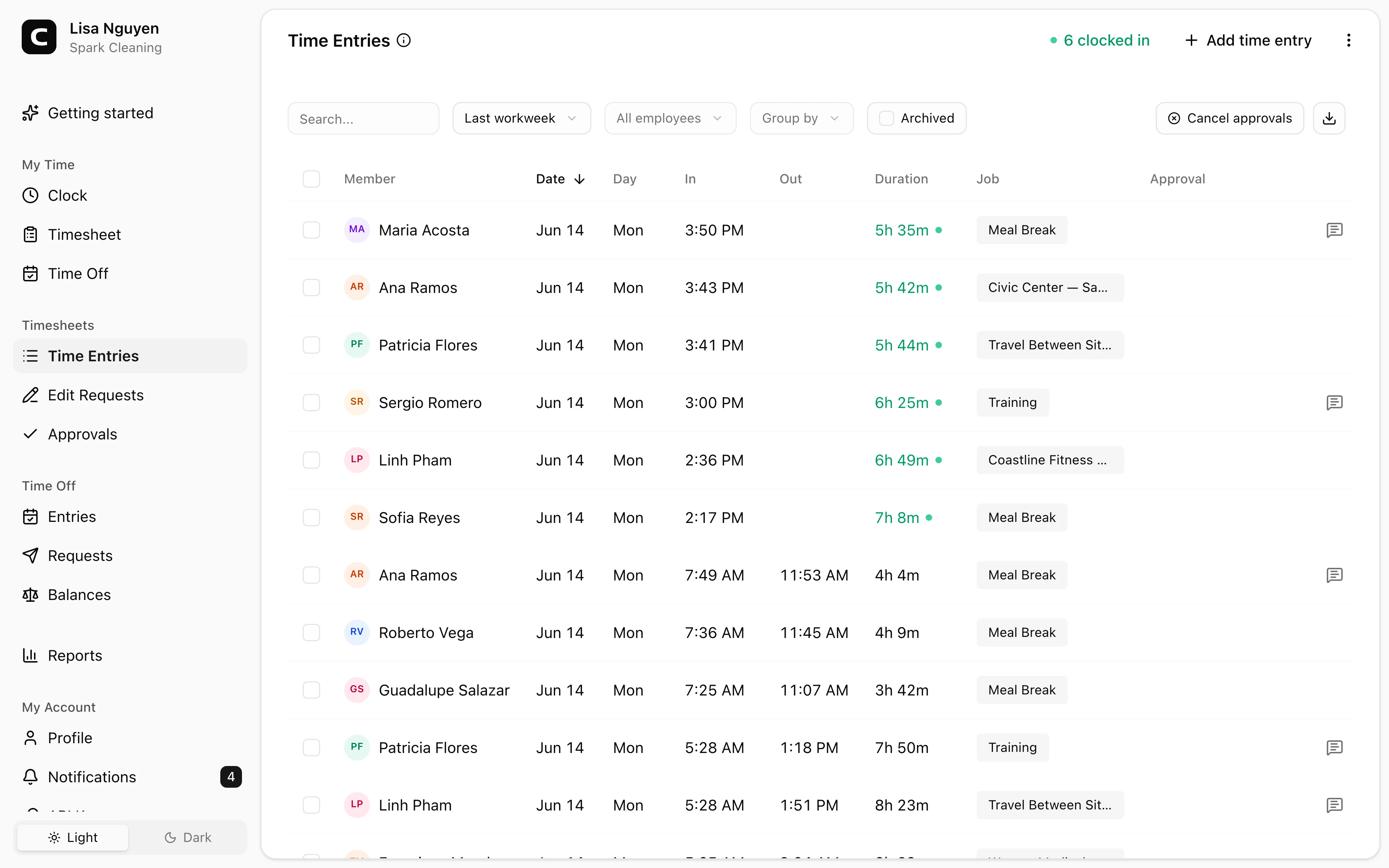
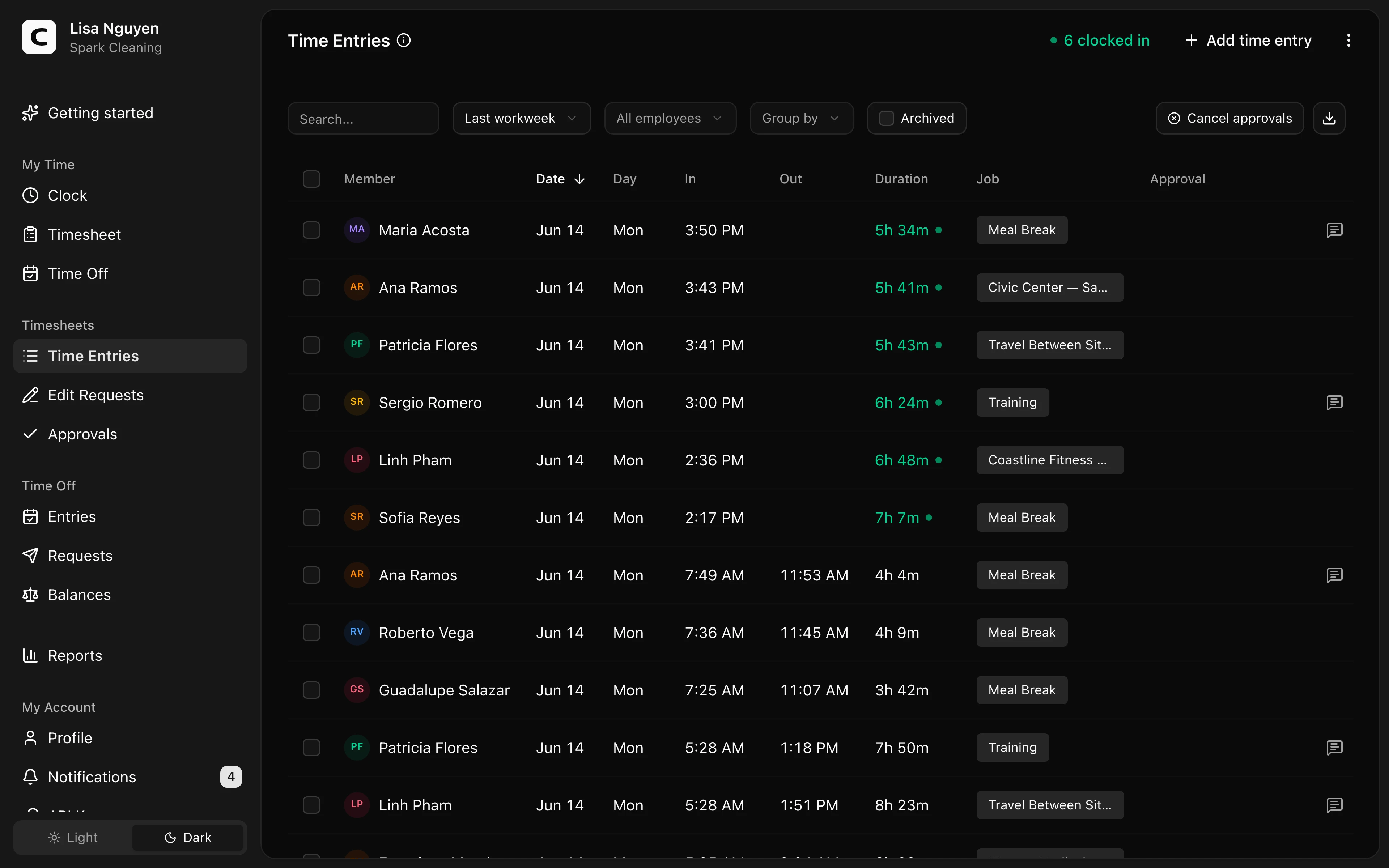
Collect clock-ins, breaks, and weekly hours without retyping minutes from a chart.
Common questions
How do I convert time card minutes to decimal hours?
Divide minutes by 60 and round to the precision your payroll system uses. For example, 30 minutes is 0.50 hours, 15 minutes is 0.25, and 45 minutes is 0.75. The converter also handles totals such as 7:30 → 7.50.
What is 7 minutes in decimal hours on a time card?
Seven minutes is 0.12 hours at two decimal places or 0.117 at three decimal places. Use the chart for exact lookups instead of estimating awkward minute values.
Is a minutes-to-decimal chart the same as time-clock rounding?
No. This chart only changes units. A time-clock rounding policy changes which minutes count before conversion. Apply any approved rounding first, or use the Time Card Calculator for punch-level rounding and weekly totals.
Should I use two or three decimal places?
Two decimal places is common on time cards and pay statements. Three decimal places reduces intermediate rounding in some systems. Match the precision required by your payroll provider.
How is this different from the Minutes to Decimal Hours Converter?
Both use the same math. This page includes the full printable chart. The Minutes to Decimal Hours Converter is a smaller two-way converter for quick calculations.
Can I print the chart?
Yes. Use the Print chart button to open your browser’s print dialog, where you can print or save a PDF.