Pay Transparency Salary Range Disclosure Helper
Pick the work state (or the state whose residents could do a remote role) and whether you are writing a job posting, talking to an applicant, or answering a current employee. See whether salary-range disclosure is required, what must be disclosed, the employer threshold, and the statute citation.
A free tool from Clockspot, employee time tracking for small businesses.
Yes — include the pay scale in any job posting (including third-party recruiter and job-board postings) when the 15-employee threshold is met.
A fully remote role open to candidates anywhere is subject to §432.3 if a California resident could perform it. Defensive posture: include a compliant California range on multi-state remote postings.
SB 642 (eff. Jan 1, 2026) tightens "pay scale" to the range reasonably expected upon hire. Labor Commissioner civil penalties $100–$10,000 per violation; first-time may be waived for good-faith cure. Separate pay-data reporting under Cal. Gov. Code §12999 for 100+ U.S. employees with 1+ in CA.
How Clockspot fits
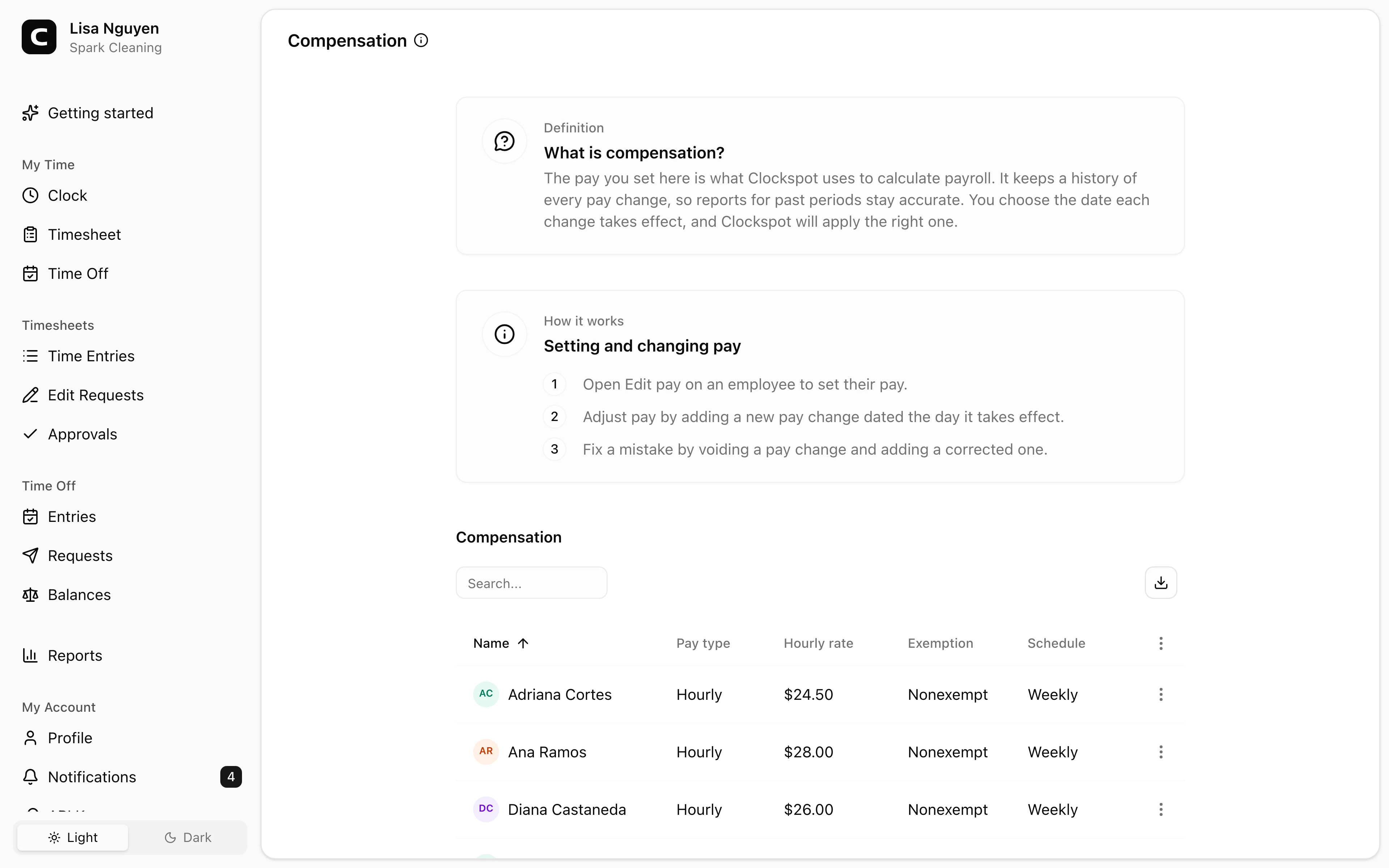
Keep pay details with each employee
Clockspot keeps hours, work locations, and effective-dated pay history together so employers can review the records behind a disclosed range.
Common questions
Does federal law require employers to post a salary range?
No. As of 2026 there is no federal statute requiring private employers to disclose a salary range in job postings. The Equal Pay Act (29 USC §206(d)), Title VII, and FLSA anti-retaliation protect against pay discrimination and protect wage discussions, but they do not create a posting obligation. Every meaningful disclosure rule is state or city law.
Which states require salary ranges in job postings?
Proactive posting laws (in force for typical mid-2026 compliance) include California, Colorado, Hawaii, Illinois, Maryland, Massachusetts, Minnesota, New Jersey, New York, Vermont, Virginia (eff. July 1, 2026), Washington, and related city rules. Connecticut and Rhode Island require disclosure on applicant request (and to employees on request) rather than a mandatory ad range. Maine takes effect July 29, 2026; Delaware September 26, 2027. DC requires min/max salary plus healthcare benefits before the first interview. Use this helper with "Job posting" selected for the state-specific answer.
What is a "good faith" salary range?
Most statutes require a good-faith estimate of what the employer reasonably expects to pay. New York City guidance frames it as the range the employer honestly believes it is willing to pay successful applicants at the time of listing. California SB 642 (eff. Jan 1, 2026) ties the pay scale to the range reasonably expected "upon hire." Ranges so wide they look evasive are the enforcement risk pattern (especially under Washington RCW §49.58.110 class actions).
Do pay-transparency laws apply to remote postings?
Often yes. Colorado reaches remote postings a Colorado resident could perform. California §432.3 reaches roles a California resident could perform. New York §194-b can reach work outside New York that reports to a New York supervisor or office. Maine (after July 29, 2026) uses "can be performed in Maine" language. The practical defensive posture is a single posting range that satisfies the strictest applicable state.
What must I tell a current employee who asks for the pay scale?
It depends on the state. California, Connecticut, Massachusetts, and Rhode Island expressly require pay-scale or wage-range disclosure to current employees on request. Colorado and New York also pull internal promotion/transfer postings into the posting rule. Many other posting states do not encode a separate employee-request right in the research table — switch this helper to "Current employee" for the modeled answer.
Is a salary-history ban the same as pay transparency?
No. A salary-history ban stops employers from asking what the candidate earned before. A pay-transparency (salary-range disclosure) law requires the employer to say what it will pay. Most disclosure states also have a history ban, but the timelines and statutes differ. Oregon bans salary-history inquiries without requiring ranges in postings.
Does this helper replace reading the statute?
No. It surfaces the research-table rule, threshold, and citation so you can act quickly, then confirm against the statute (linked when a URL is available). City ordinances (NYC, Jersey City, Ohio cities), third-party job boards, and pay-data reporting (California SB 1162, Illinois EPRC, Massachusetts EEO reporting) can add separate obligations. The companion research page has the full state-by-state table and enforcement notes.