New York City already required earned safe and sick time. The 2026 expansion adds another bank of unpaid safe and sick hours on top of that paid leave — and employers who only update a handbook line will still get the balances wrong.
ESSTA (the Earned Safe and Sick Time Act) is New York City's local leave law, enforced by the Department of Consumer and Worker Protection (DCWP). It is not optional for covered private employers with workers in the city, and it is not the same thing as New York State's paid sick leave rules. If you have even one employee working enough hours in NYC, you need a city-specific policy — not a generic "we follow New York State" handbook.
This guide is the employer-facing 2026 expansion deep-dive: what ESSTA already required, what changed for 2026, who is covered, how the unpaid frontload interacts with paid accrual, the mistakes that draw DCWP penalties, and what to fix operationally. For the national map, see paid sick leave laws by state. Primary-source depth lives in paid sick leave research.
Quick reference
- Statute: NYC Admin Code §§ 20-911 to 20-924 (ESSTA); rules under Title 6 RCNY § 7-101 et seq.
- Paid leave (unchanged structure): accrual typically 1 hour per 30 hours worked, day one. Annual paid entitlement tiers by employer size: 56 hours (100+ employees), 40 hours (5–99 employees), and 40 hours unpaid for employers with fewer than 5 employees (or covered domestic-worker situations under the ordinance).
- Carryover: mandatory for accrued paid leave; employers may cap annual use at the 40/56 tier amounts.
- 2026 expansion: 32 hours of unpaid safe and sick leave frontloaded each year, in addition to paid ESSTA leave.
- Research effective date for the 2026 amendments: March 20, 2026 (as recorded against NYC DCWP / Admin Code sources in Clockspot research). Confirm the live DCWP page before you publish final policy language.
- Penalties (still in force): up to $500 per missed leave occurrence and $1,000 per recordkeeping violation under § 20-924 — stackable.
- Not the whole story: ESSTA also covers safe time (not only personal illness), notice and documentation limits, anti-retaliation rules, and multi-year record retention. State PFML and state sick leave can sit on top for the same workforce.
What ESSTA already required (the baseline you still need)
Before the 2026 expansion, ESSTA already meant:
- Coverage for employees who work in New York City once they meet the city's hour threshold (research and the parent article treat coverage as reaching employees working 80+ hours in the city under the ordinance framework).
- Accrual of paid safe/sick time at 1:30, generally from day one of employment.
- Size-tier annual paid amounts (56 / 40 / small-employer unpaid paid-leave tier as summarized above).
- Mandatory carryover of accrued paid balances, with an employer option to cap how much can be used in a year at the tier amount.
- Safe time uses beyond personal illness (for example, needs related to domestic violence, sexual offenses, stalking, or family offenses — the ordinance's safe-time purposes).
- Reasonable notice rules (foreseeable leave can require advance notice within city limits; unforeseeable leave is "as soon as practicable," not a rigid multi-day barrier).
- Documentation limits for short absences (city rules allow documentation after longer consecutive absences — commonly framed around more than three consecutive workdays — not for every single sick day).
- No retaliation for using protected leave, including no-fault attendance points that punish protected absences.
- Recordkeeping for leave accrual, use, and balances for multi-year retention (city recordkeeping is among the longer municipal retention regimes; keep sick-leave records with payroll discipline).
Earlier city amendments already removed the old long waiting period for using paid ESSTA leave. Do not rebuild a 120-day "probation before any sick time" rule in a 2026 handbook refresh — that is how employers reintroduce a violation while "updating for the expansion."
What changed in 2026: the unpaid 32-hour bank
The load-bearing 2026 change in Clockspot's paid-sick research and parent article is:
Employers must frontload 32 hours of unpaid safe and sick leave each year, on top of the existing paid ESSTA entitlement.
Practical meaning:
- Frontloaded means the unpaid hours are available up front for the coverage year — not drip-accrued like the paid bank.
- Unpaid means the employee can take protected time off without pay for covered safe/sick reasons under the ordinance, separate from paid ESSTA hours.
- In addition to paid leave means you cannot treat the 32 unpaid hours as a substitute for the paid 40/56-hour bank. Employees who previously only saw one sick-leave balance may now need two (paid ESSTA + unpaid ESSTA expansion).
- Annual means the unpaid bank is a yearly grant, not a lifetime pile that automatically mimics paid carryover rules. Research frames the unpaid entitlement as frontloaded annually; do not invent carryover of unpaid hours unless your counsel confirms a later DCWP FAQ that requires it.
Research records the 2026 amendments as effective March 20, 2026. Law-firm SERP commentary around the expansion has used other early-2026 dates for related notices and rollouts. For operations, treat March 20, 2026 as the research-anchored effective date and verify the current NYC DCWP ESSTA page before you lock payroll configuration or employee notices.
What this article does not claim
Secondary writeups (employment-law firm alerts) have discussed additional 2026 NYC leave topics such as prenatal leave banks or new notice-of-rights deadlines. Those details are not verified in Clockspot's paid-sick research package. This article stays inside research- and parent-article-verified ESSTA points: paid tiers, the 32-hour unpaid frontload, penalties, coverage structure, and operational controls. If DCWP publishes a new notice template or prenatal rule, update policy from the DCWP page — do not invent it from a blog.
Who must comply
- Private employers with employees performing work in New York City under ESSTA coverage rules.
- Size still matters for paid tiers. The 56-hour vs 40-hour paid annual amounts track headcount bands (100+ vs 5–99). Smaller employers already had a different paid/unpaid mix under the base ordinance; the 2026 unpaid frontload is an additional unpaid bank, not a reason to ignore the paid tier you already owed.
- Part-time, temporary, and seasonal employees are not automatically excluded once they meet coverage. Misclassifying workers as independent contractors does not erase ESSTA if the worker is really an employee under New York tests.
- Remote and multi-site employers. Work location controls leave. A New Jersey HQ with staff on-site in Manhattan still owes NYC ESSTA for NYC work. A remote employee who works from Brooklyn is not governed by the HQ state's "we don't do sick leave" default.
- Healthcare, hospitality, retail, cleaning, and professional services all land here when the work is in the city. Industry is not an automatic out.
How paid + unpaid banks interact (operations)
| Bank | How it is earned / granted | Paid? | 2026 note |
|---|---|---|---|
| ESSTA paid safe/sick | Accrue 1:30 (or lawful frontload of paid amount) | Yes | Still required; size tier 40/56 (or small-employer structure) |
| ESSTA unpaid expansion | Frontload 32 hours per year | No | New 2026 layer on top of paid leave |
| NY State paid sick leave | State law tiers (separate statute) | Varies | Can apply to the same employee; coordinate policies |
| Company vacation / PTO | Policy | Usually | Do not merge into sick if it blurs legal banks |
Operational rules of thumb:
- Show separate balances in the system employees and managers use: paid ESSTA, unpaid ESSTA (32h), and any other leave types.
- Do not force employees to exhaust unpaid hours first as a way to avoid paying ESSTA paid leave when paid leave is available and the absence is covered — follow the ordinance and DCWP guidance on sequencing; when unsure, get counsel rather than invent a sequence that always favors the employer.
- Train managers that unpaid protected leave is still protected. "It's unpaid, so attendance points are fine" is how retaliation claims start.
- Payroll and timekeeping must record leave use dates and which bank was charged. DCWP penalties attach to missed leave and recordkeeping failures separately.
The expensive mistakes for 2026
-
Ignoring the unpaid bank because "we already give 40/56 paid hours." The expansion is additive. Paid compliance does not satisfy the unpaid frontload.
-
Reintroducing a waiting period while rewriting the handbook for 2026. Paid ESSTA use is not supposed to sit behind an old 120-day wall. New hires need a clear story for paid accrual/use and the unpaid frontload timing.
-
One PTO bucket for everything. Merging vacation, paid sick, and the new unpaid safe/sick hours hides legal balances, breaks carryover math, and creates payout confusion at termination (vacation payout rules and sick-leave non-payout norms are different problems — see vacation payout laws by state).
-
Attendance points on protected ESSTA absences. City and state sick-leave regimes treat adverse action for protected use as unlawful. A no-fault point for a documented ESSTA day is a classic enforcement pattern.
-
HQ policy for NYC workers. Applying New Jersey, Texas, or Florida "no sick leave" defaults to Manhattan staff is the multi-jurisdiction miss the parent sick-leave article flags every time.
-
Missing records. § 20-924's $1,000 per recordkeeping violation is not a rounding error when DCWP multiplies across employees and years. Keep accrual, frontload grants, use, and balances.
Employer checklist for the 2026 expansion
- Confirm who works in NYC (site-based, hybrid, remote living in the city, multi-borough routes).
- Confirm headcount tier for paid ESSTA annual amounts (5–99 vs 100+; small-employer structure if under 5).
- Add a 32-hour unpaid safe/sick bank frontloaded per the ordinance year — separate from paid ESSTA.
- Update the written policy and any employee notice materials you already issue under ESSTA so both banks are described in plain language.
- Configure time-off software with two ESSTA banks (paid + unpaid), correct accrual or frontload rules, and manager visibility.
- Retrain managers on protected use, notice, documentation limits, and attendance discipline.
- Audit last year's denials and points for patterns that would violate ESSTA if repeated under the expanded banks.
- Align NY State paid sick leave and any company PTO so employees are not forced into illegal sequencing or under-accrual.
- Retain leave records with payroll-level discipline for the multi-year city retention window.
- Recheck NYC DCWP's ESSTA page when you change systems — city guidance and FAQs move faster than handbooks.
For accrual math on the paid bank, the PTO accrual calculator can model 1:30 balances; configure the unpaid 32-hour bank as a frontload grant in your time-off product rather than forcing it through accrual math it was not designed for.
Explore the sample account
Carolina Home Services is an example contractor in Charlotte, North Carolina, with employee time cards, jobs and Work Sites, trade qualifications, approvals, and reports already filled in with sample data.
No login required. Opens in one click.
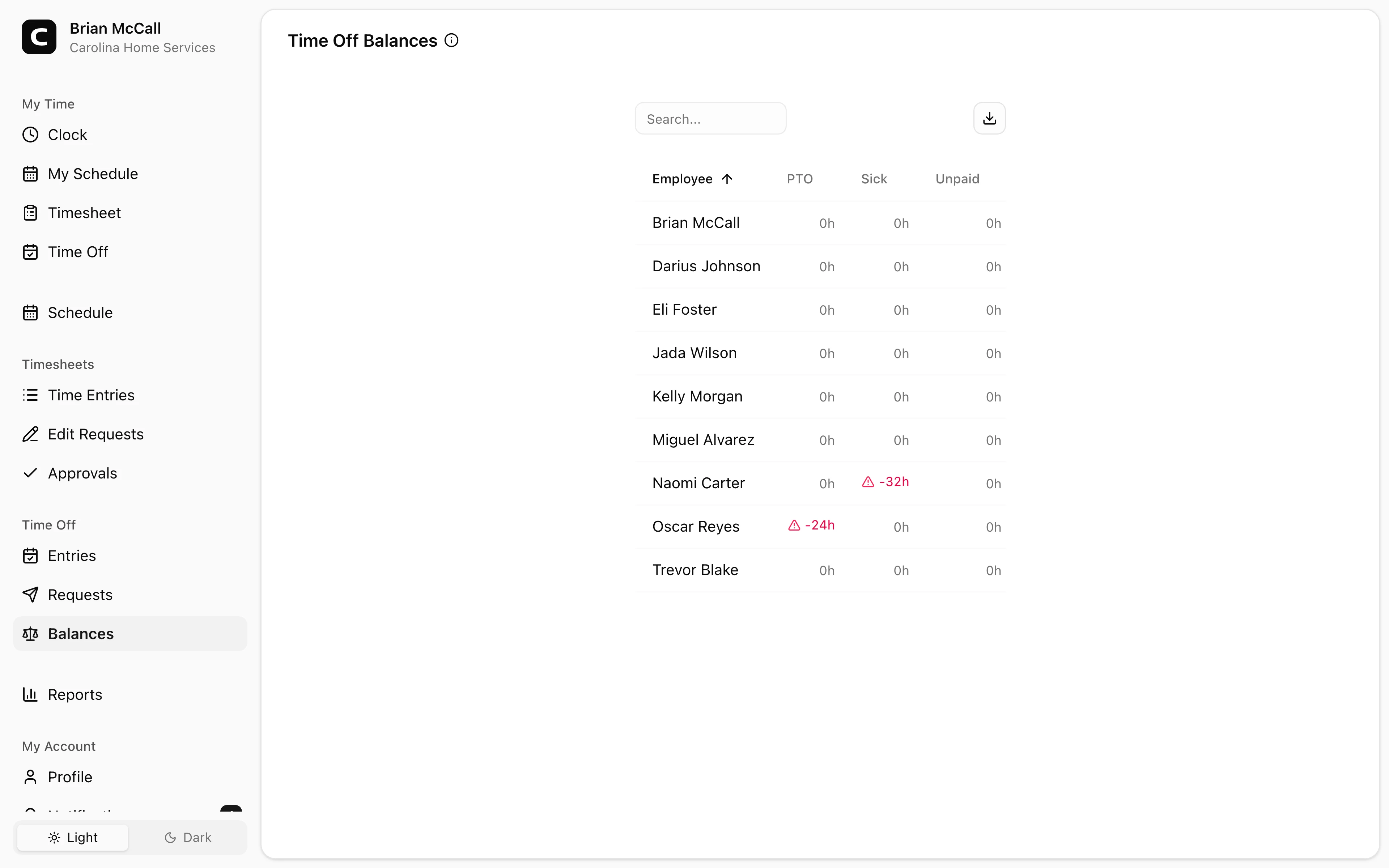
The demo is useful when you need one place for time worked and time off requests so paid ESSTA use, unpaid protected days, and payroll export stay on the same audit trail.
When to get help
- You operate multiple boroughs or mix NYC work with Westchester / NJ / remote states.
- You are merging companies or PE-backed rollups with different leave banks mid-year.
- DCWP has opened an inquiry, or employees have filed sick-leave complaints.
- Your handbook still has a waiting period, a single PTO bucket, or attendance points on sick days.
- You need a formal legal opinion on sequencing paid vs unpaid ESSTA for a disputed absence.
This page is practical compliance orientation for employers, not legal advice for a specific workforce.
Rule of thumb
Keep paid ESSTA and the 2026 unpaid 32-hour bank as separate, tracked entitlements — and never assume a state or HQ policy covers New York City. For the one-minute version, see what's changing with NYC ESSTA in 2026. For the national leave map, return to paid sick leave laws by state.
Clockspot keeps clock-ins, corrections, approvals, and payroll-ready hours connected so owners and managers can review the workweek before payroll.
Clockspot helps NYC employers track time off balances, requests, and payroll-ready records in one place. See how Clockspot tracks sick leave.