Hover a state for the pregnancy-accommodation overlay — federal PWFA still applies at 15+ everywhere private employers are covered.
Federal law no longer lets you answer pregnancy with unpaid leave first. For employers with 15 or more employees, the Pregnant Workers Fairness Act requires reasonable accommodations so the worker can keep working — unless you can show real undue hardship. Put someone on leave because a stool, water bottle, restroom breaks, or a schedule tweak would have worked, and you have already walked into the statute's most common failure mode.
Before June 2023, most pregnancy-accommodation fights ran through the Pregnancy Discrimination Act — a same-treatment rule that asked whether you treated pregnant workers like non-pregnant workers "similar in their ability or inability to work." The Supreme Court in Young v. UPS made that comparison workable, but it still left employers free to deny light duty when no clear comparator existed. The PWFA flipped the default: accommodation is now an affirmative duty, not a scavenger hunt for comparators.
The federal floor is uniform. What changes by state is the overlay: lower headcount thresholds, no-documentation rules for simple fixes, multi-month pregnancy disability leave (California), and paid lactation or paid family leave that stack after the worker returns or when leave is actually needed. Primary-source depth lives in pregnancy accommodation and family leave research. Sibling guides cover lactation break laws by state and paid family and medical leave by state.
Quick reference
- Federal duty: reasonable accommodation of a known limitation related to pregnancy, childbirth, or related medical conditions, absent undue hardship — effective June 27, 2023.
- Coverage: private and public employers with 15 or more employees (same Title VII headcount).
- EEOC Final Rule: 29 CFR Part 1636 effective June 18, 2024 — predictable assessments, documentation limits, temporary suspension of essential functions.
- Four predictable assessments (pregnant employee; virtually never undue hardship): water as needed; additional restroom breaks as needed; sit if the job requires standing / stand if it requires sitting; breaks to eat and drink as needed.
- Cannot force leave when another effective accommodation would let the employee keep working.
- Cannot dictate the fix — the accommodation must come from an interactive process, not a one-way reassignment.
- No doctor's note for the four predictable assessments, for lactation/pumping/nursing modifications, or when the need is obvious or already known.
- State overlays that commonly beat the federal floor: California (5+; up to 4 months PDL), Minnesota (1+; no-doc seating/breaks/20-lb lift), New Jersey (near-universal NJLAD coverage), New York (4+ under Human Rights Law), Massachusetts (6+), Illinois (1+ for pregnancy provisions), Connecticut (3+).
- Litigation currency (mid-2026): Fifth Circuit Texas v. Bondi is in en banc rehearing after the August 2025 panel opinion was vacated — treat private-employer PWFA as intact nationwide; do not invent an en banc merits holding. A Louisiana district court vacated elective-abortion portions of the Final Rule only.
The 5 most expensive pregnancy-accommodation mistakes
-
Forcing leave instead of keeping the employee working. Maria is a shift lead at a 40-person cafe group. She asks for a stool and more frequent water breaks during first-trimester nausea. The manager puts her on unpaid leave "until she feels better." That is the classic forced-leave failure: leave was the employer's preference, not the last remaining option. Exposure tracks Title VII-style remedies — back pay, compensatory damages, and (subject to statutory caps) punitive damages, plus attorney fees.
-
Treating every request like a full medical workup. The Final Rule sharply limits when you may demand supporting documentation. It is not reasonable to require a doctor's note for the four predictable assessments, for lactation-related modifications, when the limitation is obvious, or when you already have enough information. Minnesota independently forbids requiring proof for restroom/food/water breaks, seating, and a 20-pound lifting limit — for every employer. Serial notes for water breaks are both a documentation problem and retaliation evidence.
-
Skipping the interactive process and dictating the fix. A warehouse supervisor who unilaterally reassigns a pregnant picker to the night shift "as the accommodation," without asking what the employee needs, has already violated the statute — even if a different accommodation would have been lawful. Unnecessary delay can also violate the PWFA even when something is eventually granted.
-
Confusing PWFA accommodation with FMLA leave designation. PWFA keeps people working with schedule changes, light duty, temporary suspension of essential functions, telework, or equipment changes. FMLA (and state PFML) covers blocks of leave for birth, bonding, and serious health conditions. Never designating FMLA when leave becomes FMLA-qualifying can leave the 12-week clock uncharged — a coordination problem covered in paid family and medical leave laws by state. The reverse error is also expensive: treating every accommodation request as "start your FMLA" is forced leave in disguise.
-
Ignoring the work-location state overlay for remote and multi-state staff. A Texas-headquartered company with one remote employee in Minnesota still owes Minnesota's all-employer pregnancy-accommodation rules. Work location usually controls the state overlay. Missing that stack produces state-agency charges on top of any EEOC charge.
What the federal PWFA actually requires
The operative duty is short: covered employers must make reasonable accommodations to the known limitations related to pregnancy, childbirth, or related medical conditions of a qualified employee, unless the employer can show undue hardship.
Known limitation is broader than "ADA disability." Modest, minor, or episodic conditions count. Seeking health care for the pregnancy itself counts. The employee (or a representative) has to communicate the limitation — magic legal words are not required. "I need more bathroom breaks because of my pregnancy" is enough.
Qualified has two paths: the employee can perform essential functions with or without accommodation, or the employee cannot perform one or more essential functions temporarily, could perform them in the near future, and the inability can be reasonably accommodated. For a current pregnancy, the Final Rule treats "in the near future" as generally within about 40 weeks of temporary suspension — a ceiling for analysis, not an automatic 40-week entitlement.
Examples of reasonable accommodations include frequent breaks; sitting/standing changes; schedule changes, part-time work, paid and unpaid leave; telework; parking; light duty; accessible facilities; job restructuring; temporary suspension of essential functions; modified equipment or uniforms; and adjusted exams or policies.
What you may not do:
| Prohibition | Practical meaning |
|---|---|
| Force an accommodation the employee did not accept through the interactive process | No one-way night-shift reassignment "as the accommodation" |
| Deny employment opportunities because someone needs an accommodation | Do not pass over a hire or promotion solely to avoid the accommodation |
| Require leave if another reasonable accommodation works | Leave is last resort when work can continue |
| Retaliate for requesting or using an accommodation | Attendance points, demotions, and "attitude" write-ups after a request are risk |
The Pregnancy Discrimination Act still bans pregnancy discrimination. The ADA can still cover pregnancy-related impairments (preeclampsia, gestational diabetes). FMLA still covers leave at 50+ employees. The PUMP Act still covers lactation break time and a non-bathroom place for one year after birth — detail in lactation break laws by state. PWFA does not replace those statutes; it fills the accommodation gap they left open.
Four predictable assessments you should almost never refuse
For a pregnant employee, four modifications will, in virtually all cases, be reasonable accommodations that do not impose undue hardship:
- Carry or keep water nearby and drink as needed
- Additional restroom breaks as needed
- Sit if the job requires standing, or stand if it requires sitting, as needed
- Breaks to eat and drink as needed
These are the operational sweet spot for small employers: low cost, high frequency, and no medical documentation required under the Final Rule. Train supervisors to grant them in the moment rather than routing every water-bottle request through HR and a clinic.
High-impact state overlays
Federal PWFA is the floor for 15+ employers. These states either cover smaller shops, ban documentation for simple fixes, or stack multi-month leave on top.
California — PDL, CFRA, and the strictest stack
California employers with five or more employees owe:
- Up to four months of job-protected Pregnancy Disability Leave while the employee is disabled by pregnancy, childbirth, or a related condition
- Reasonable accommodations and, when medically advised and reasonably accommodable, temporary transfer to less strenuous or hazardous work
- CFRA bonding leave (also at 5+), generally after PDL ends for birth — not as a single 12-week bank
- Written lactation policy and break/space rules under Labor Code §§ 1030–1034 (see the lactation guide)
Wage replacement during those periods often comes from State Disability Insurance and Paid Family Leave through EDD — covered in the PFML guide. An employee who can keep working with a lifting restriction is not required to start PDL.
Minnesota — every employer, three no-doc fixes
Minnesota covers all employers regardless of size. On request, provide without documentation: more frequent or longer restroom, food, or water breaks; seating; and a limit on lifting more than 20 pounds. Beyond those three, engage for other reasonable accommodations absent undue hardship. Minnesota also provides up to 12 weeks of unpaid pregnancy and parenting leave from day one of employment, and paid lactation break time with no headcount floor.
New Jersey, New York, Massachusetts, Illinois, Connecticut
| State | Threshold | What employers miss |
|---|---|---|
| New Jersey | Near-universal under NJLAD | State pregnancy-accommodation duty even when federal PWFA would not apply |
| New York | 4+ (Human Rights Law) | Accommodation under HRL plus paid 30-minute lactation breaks for up to 3 years |
| Massachusetts | 6+ | Full PWFA-style package, forced-leave ban, written notice of rights |
| Illinois | 1+ for pregnancy provisions | Affirmative accommodation; paid lactation rules for many employers from Jan 1, 2026 |
| Connecticut | 3+ | Forced-leave ban, written notice, lactation in the accommodation definition |
The full 50-state orientation table — including states that still rely on the federal floor for private-employer accommodation — is in the companion research. City ordinances (for example New York City) can add duties below state thresholds.
How PWFA sits next to leave and lactation
| Framework | What it does | Typical size gate |
|---|---|---|
| PDA / Title VII | Bans pregnancy discrimination; same-treatment after Young | 15+ |
| PWFA | Affirmative reasonable-accommodation duty | 15+ |
| ADA | Some pregnancy-related impairments; pregnancy alone usually is not a disability | 15+ |
| FMLA | Unpaid job-protected leave for birth, bonding, serious health condition | 50+ / hours / 75-mile tests |
| PUMP Act | Lactation break time + non-bathroom place for 1 year | FLSA-covered; <50 may claim undue hardship |
| State PFML | Paid wage replacement + often broader job protection | Varies; often 1+ in-state |
Practical stack for a mid-size employer: use PWFA (and any stricter state accommodation statute) to keep the employee working through pregnancy; use FMLA/CFRA/state leave when the employee needs leave for recovery or bonding; use PUMP Act + state lactation rules on return; use state PFML for wage replacement where it exists. Do not pick one statute and ignore the others.
For a 60-second answer on when the federal duty fires, see when the Pregnant Workers Fairness Act applies. For paid leave contributions and remote-worker setup, see where you owe paid family leave. For pump space and paid-break states, see when pump breaks have to be paid.
Multi-state and remote workers
Work location generally controls the state overlay. Federal PWFA applies by employer headcount nationwide. State accommodation, lactation, and leave statutes usually follow where the employee works.
Scenario 1 — Texas HQ, Minnesota remote employee. Jen works fully remote from Minneapolis for a 60-person Austin company. The employer owes federal PWFA (15+). It also owes Minnesota's no-doc pregnancy accommodations, paid lactation rules, and 12-week pregnancy/parenting leave — even though Texas has no freestanding private-employer pregnancy-accommodation statute.
Scenario 2 — California field tech on a temporary Nevada project. Marcus is based in Sacramento (PDL/CFRA/lactation policy apply) and spends six weeks on a Nevada job site. Confirm which rules attach to work performed there; do not drop California handbook rights solely because the temporary site is out of state without checking the assignment structure.
Scenario 3 — Under-15 total headcount in a strict state. A franchise brand with 12 employees total in Connecticut is under Connecticut's 3+ pregnancy-accommodation statute even though federal PWFA does not yet apply. Headcount is measured under each statute's own rule — often enterprise-wide, not per store.
Recent changes employers should track
- June 18, 2024 — EEOC PWFA Final Rule effective. Predictable assessments and documentation limits become the day-to-day compliance text.
- December 2024 — New Jersey Division on Civil Rights issues updated pregnancy-related workplace accommodations guidance under NJLAD.
- May 21, 2025 — Western District of Louisiana vacates portions of the EEOC Final Rule that required employers to accommodate elective abortions. Other pregnancy-related limitations in the rule were not erased by that order. Confirm the order text and any appeal posture before relying on residual coverage for that narrow issue.
- August 15, 2025 / January 14, 2026 — Fifth Circuit panel in State of Texas v. Bondi reversed a Northern District of Texas injunction limited to the State of Texas as employer; the panel opinion was later vacated when the court granted en banc rehearing (argument set for May 12, 2026). As of mid-2026, treat the private-employer PWFA duty as intact nationwide. Enforcement against Texas state agencies is litigation-dependent — verify the live injunction status before advising a public employer in Texas. Do not invent an en banc merits holding.
- January 1, 2026 — Illinois paid lactation-break amendment effective for employers with more than five employees (detail in the lactation cluster).
- State PFML expansion continues — Delaware, Minnesota, and Maine benefits phases (and future Maryland/Virginia dates) change bonding and medical-leave wage replacement, not the PWFA accommodation duty itself. Track those in the PFML article.
Records that prevent the claim
Pregnancy-accommodation exposure is usually a process failure, not a mystery of statutory text:
- Request log — date the employee (or representative) communicated a limitation and need for a change.
- Interactive-process trail — short emails or notes showing options considered, what the employee accepted, and why alternatives were rejected.
- Schedule, break, and location data — extra restroom breaks, sit/stand changes, water access, telework days, and light-duty hours need a time-and-attendance trail so payroll and supervisors apply the same rule.
- Leave concurrent designation — when accommodation becomes leave, designate FMLA within five business days of acquiring knowledge of a qualifying reason and track state PFML/CFRA/PDL clocks separately where they stack.
- Documentation decisions — if you asked for a doctor's note, record why it was reasonable. If you did not ask — the correct path for predictable assessments and lactation — record that too.
- Work-location assignment — multi-state compliance fails when HR assumes headquarters law.
When accommodation turns into leave banks and return-to-work schedules, you need the same system that already tracks time off and hours:
Explore the sample account
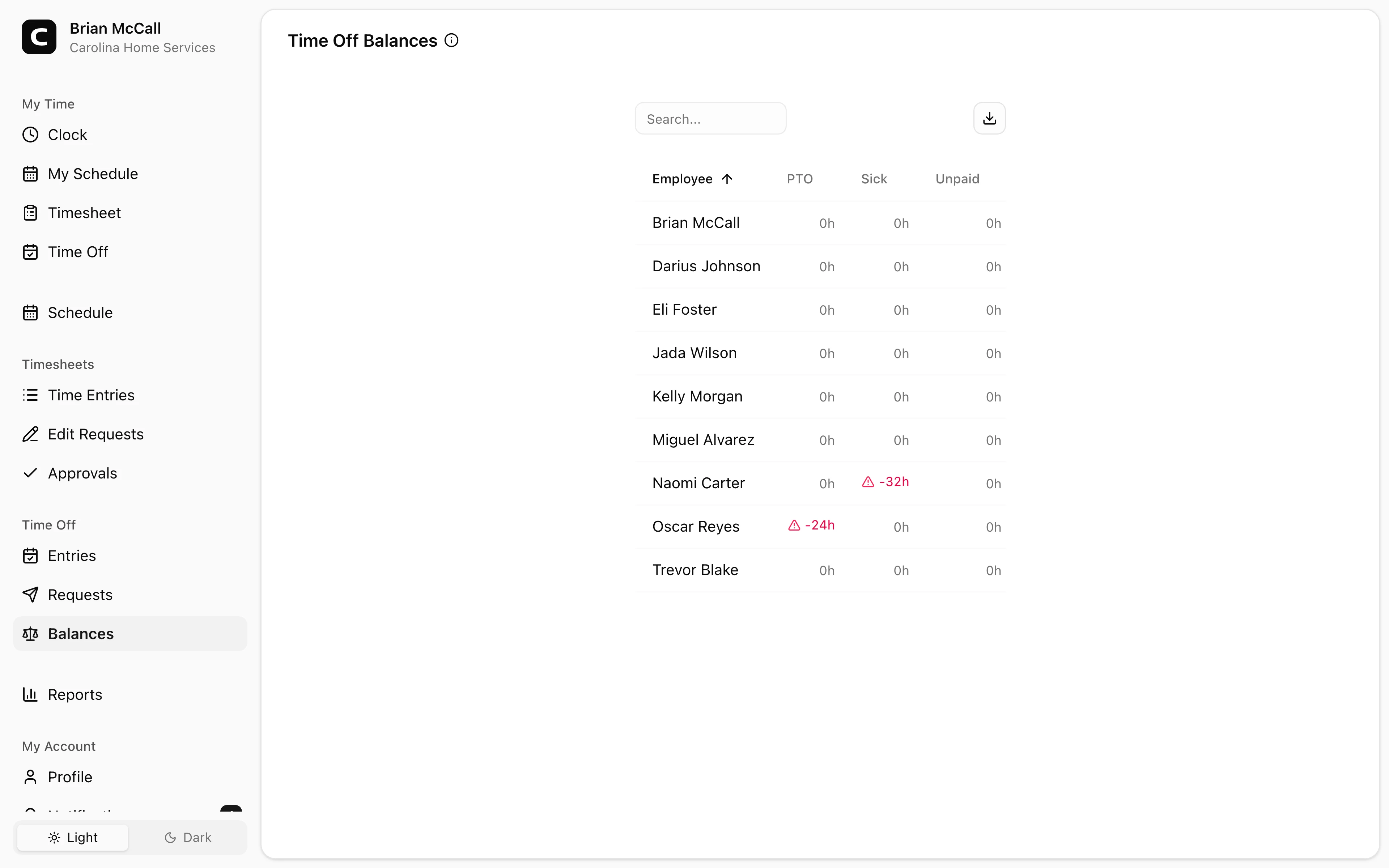
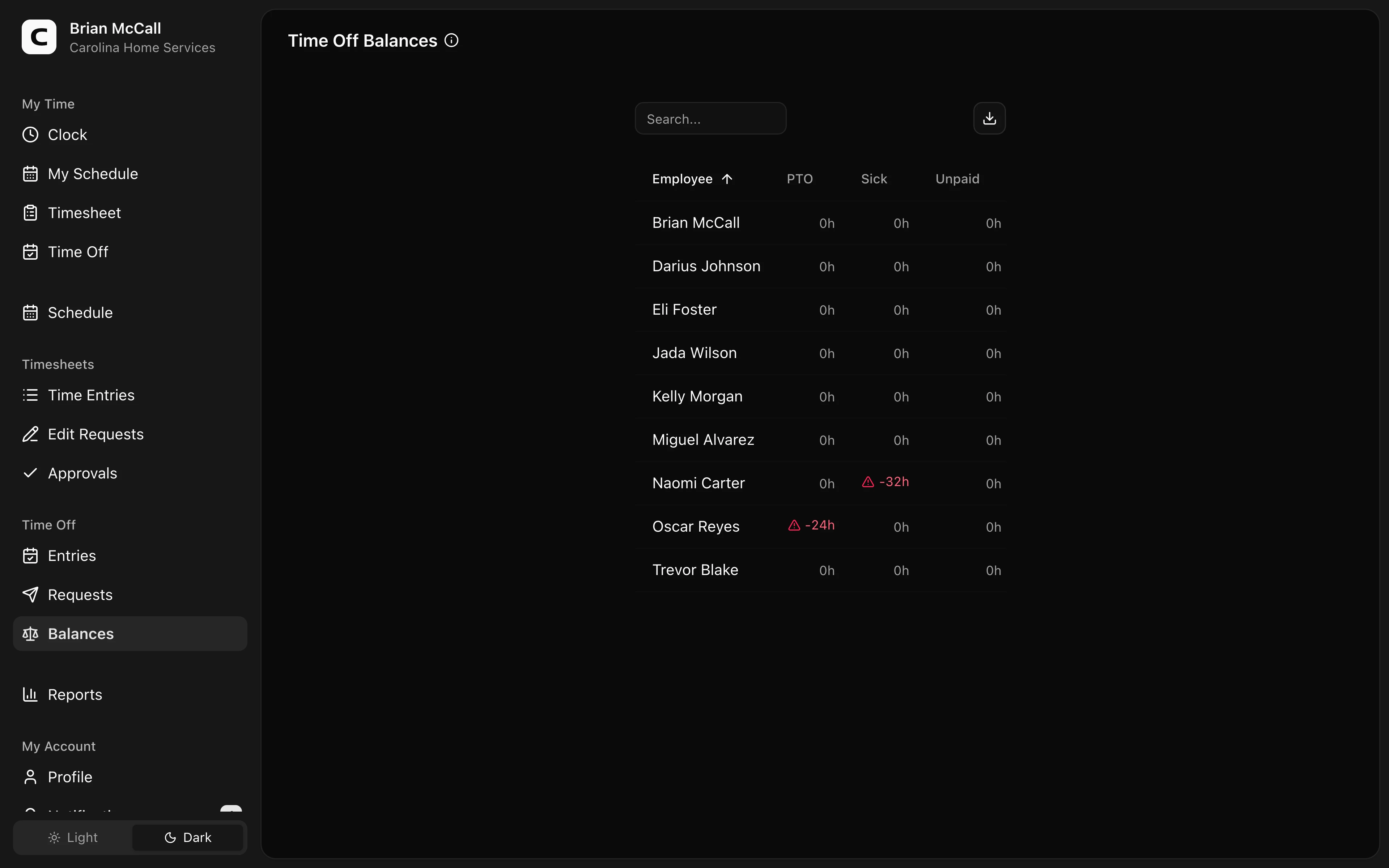
Carolina Home Services is an example contractor in Charlotte, North Carolina, with employee time cards, jobs and Work Sites, trade qualifications, approvals, and reports already filled in with sample data.
No login required. Opens in one click.
Frequently Asked Questions
Does the PWFA apply if I have fewer than 15 employees?
Federal PWFA does not. But several states cover smaller employers — including California (5+), Minnesota (1+), Illinois (1+ for pregnancy provisions), Connecticut (3+), New York (4+), and Massachusetts (6+). Check the employee's work state before you assume the federal headcount is the whole answer.
Can I require a doctor's note for extra bathroom breaks?
Under the federal Final Rule, no — additional restroom breaks as needed are one of the four predictable assessments for a pregnant employee, and documentation is not reasonable for those modifications. Minnesota independently forbids requiring proof for restroom/food/water breaks, seating, and a 20-pound lifting limit. Save documentation requests for non-obvious limitations where the rule still permits reasonable confirmation.
Does the PWFA require me to create light-duty jobs that do not exist?
Not automatically. Light duty can be a reasonable accommodation when you have a light-duty program or can temporarily restructure duties without undue hardship. The Final Rule also allows temporary suspension of essential functions when the inability is temporary, the employee could perform them in the near future, and the suspension can be reasonably accommodated. "We don't have light duty" is the start of the interactive process, not the end of it.
How does PWFA interact with FMLA leave for childbirth?
They solve different problems. PWFA accommodations try to keep the employee working. FMLA provides unpaid job-protected leave for qualifying birth, bonding, and serious health conditions at covered employers. An employee may use PWFA accommodations during pregnancy, then FMLA (and state leave) for recovery and bonding. When leave is FMLA-qualifying, designate it — skipping designation can leave the 12-week entitlement uncharged.
Do state laws still matter if I already comply with the federal PWFA?
Yes. States can cover smaller employers, ban documentation for more categories, require longer disability leave (California PDL), mandate paid lactation breaks, or add notice-posting duties. The PWFA expressly preserves more protective federal, state, and local laws.
What if a supervisor already told the employee to "just take leave"?
Treat it as a live compliance event. Re-open the interactive process in writing, identify accommodations that would allow work to continue, correct any forced-leave instruction, and train the supervisor. Retaliation and adverse-action theories attach quickly once a request has been made.
Are elective abortion accommodations required under the PWFA Final Rule?
As written in 2024, the EEOC's Final Rule treated abortion as within "pregnancy, childbirth, or related medical conditions." A Western District of Louisiana order on May 21, 2025 vacated the portions of the rule requiring accommodation of elective abortions. Do not invent broader holdings; verify the current regulatory text, the vacatur's scope, and any appeal before giving operational advice on that narrow issue. Other pregnancy-related limitations in the rule were not erased by that order.
Is pregnancy itself a disability under the ADA?
Usually no. Pregnancy alone is not an ADA disability, but impairments related to pregnancy (for example preeclampsia or gestational diabetes) may be. The PWFA exists partly because the ADA path was incomplete for uncomplicated pregnancies that still need workplace adjustments.
If you discover you've been doing this wrong
- Inventory open pregnancies and recent requests. List every employee who asked for a schedule change, lifting help, extra breaks, remote work, or leave related to pregnancy or postpartum recovery in the last 300 days.
- Reconstruct the interactive process. For each request, document what was asked, what was granted, whether leave was forced, and whether any documentation demand exceeded the Final Rule.
- Fix active arrangements now. Swap forced leave for workable accommodations where the employee can return; correct break, seating, and water access immediately when they match predictable assessments.
- Align leave designations. Where recovery or bonding leave was taken, confirm FMLA/state leave notices were issued and clocks were charged correctly; coordinate with PFML wage-replacement claims where relevant.
- Train supervisors and update the written policy. First-line managers receive most requests. Publish a short accommodation procedure, the state-specific notice where required (MA, CT, CA lactation policy, MN WESA notice), and a work-location checklist for remote staff.
The through-line
Pregnancy accommodation is no longer a comparator scavenger hunt — for covered employers it is an affirmative duty to keep people working when a reasonable adjustment exists. The federal PWFA and the EEOC Final Rule set that floor. California PDL, Minnesota WESA, New Jersey NJLAD, New York Human Rights Law, Massachusetts c. 151B, and Illinois IHRA push below the 15-employee line or add leave and notice duties on top.
The failure modes that compound: forcing leave when a stool or schedule tweak would have worked; demanding medical notes for predictable assessments; dictating the accommodation without an interactive process; mixing up accommodation and FMLA designation; applying headquarters law to a remote employee in a stricter state.
When in doubt, document the request, offer a temporary adjustment that keeps the employee working, and track schedules, breaks, leave, and work location in the same system that already runs payroll. The interactive-process record and the time-and-attendance trail are what make a good-faith defense real when the EEOC charge arrives.
Clockspot keeps clock-ins, corrections, approvals, and payroll-ready hours connected so owners and managers can review the workweek before payroll.
Pregnancy accommodations show up as schedule changes, extra breaks, light-duty hours, and leave windows. Clockspot keeps the work-location, time, and time-off records that make the interactive process and concurrent leave designation defensible. See how Clockspot supports schedule and leave records.