Reports
Attendance Exceptions
Find scheduled absences, missing clock-outs, unscheduled work, and scheduled-hour variances.
No login required. Opens in one click.
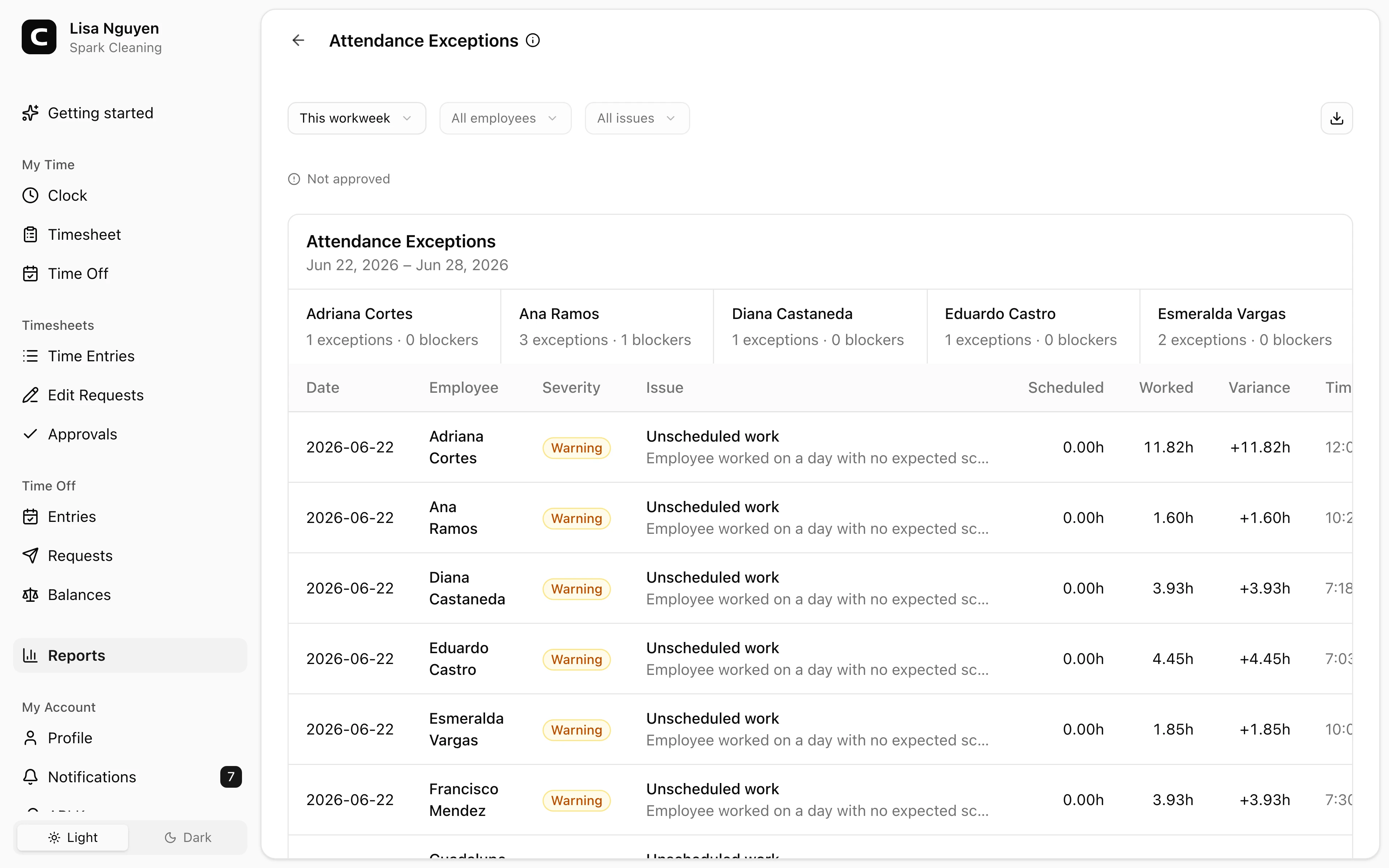
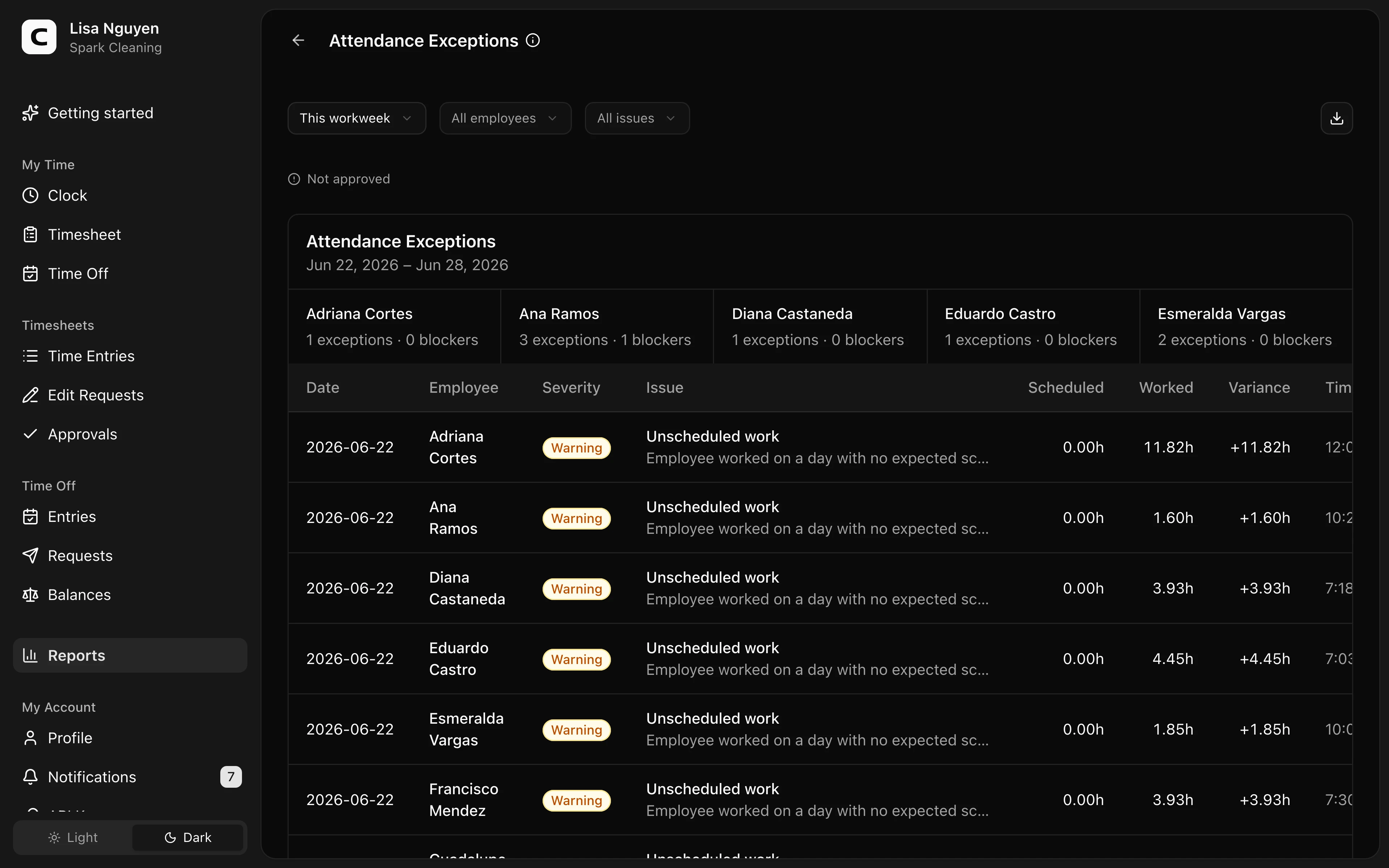
What this report shows
Attendance Exceptions lists scheduled and time-entry situations that usually need manager review:
- Absent scheduled day
- Missing clock-out
- Unscheduled work
- Short scheduled day
- Long scheduled day
Each row shows Date, Employee, Severity, Issue, Scheduled, Worked, Variance, and Time. Severity is Blocker or Warning.
When the selected period has approval data, a status line above the report shows whether timesheets are approved, not approved, or partly approved.
Filters
Use the date range, All employees, and All issues controls in the toolbar. The report uses each employee's work schedule to decide which days were scheduled and how many minutes were expected.
What to do with a row
The report is read-only. Use it to find the item that needs review, then open Time entries, Approvals, or Employees depending on whether the issue is a bad time entry, an approval state, or a schedule setup question.
Exporting
Open the Export menu and choose Download CSV, Download Excel, or Download PDF. The export includes the exception rows and the same issue and severity labels shown in the table.
Common questions
- Why does the report not show late arrivals or early departures?
Clockspot work schedules store expected minutes by weekday, not shift start and end times. The report can compare scheduled minutes with worked minutes, but it does not infer arrival or departure rules.
- A day is marked Absent scheduled day but the employee was on time off.
Check the employee's time off entry for that date on Time Off Entries. This report focuses on scheduled work and clocked time; time off totals are easier to review in Time Off Usage & Balances.
- Why does a missing clock-out matter before payroll?
An open entry can keep completed hours from being final. Fix the entry on Time entries before relying on period totals.
Related
How overtime works
How Clockspot classifies overtime hours into report tiers.
Running payroll
The path from a closed pay period to numbers you can hand to your payroll provider.
Reports
Open the report that matches the hours, payroll, job, or clock-location question you need to review.
Current Status
See who is clocked in, on time off, scheduled today, or off duty right now.
Daily Summary
Review one day's clock activity, open punches, time off, pending edits, and cleanup items.
Attendance
See who worked each day, with hours, absences, and in/out times.
Hours Summary
See each employee's regular, overtime, and time off hours for the period.
Overtime
See who hit overtime each week, with the rule behind each tier.
Payroll Readiness
Check payroll blockers, warnings, and cleanup actions before using payroll totals.
Payroll Summary
See payroll-ready hours and pay per employee, ready to process.
Timesheet Audit
Review direct edits and edit requests with who changed what, when, and why.
Job Hours
See how employee hours break down by job and project.
Labor Cost by Job
See hours, straight-time pay, overtime premium, and labor cost by job.
Time Off Usage & Balances
Compare time off used, pending requests, current balances, and balances after pending.
Verification Exceptions
Review clock events missing expected location, kiosk-photo, or phone voice evidence.
Location Summary
See how hours and headcount break down across clock locations.
Location Activity
See the clock-in and clock-out location for every shift.
Location Compliance
Find time entries with missing or mismatched clock locations.
Location Coverage
Compare where each employee worked, by location and by day.
GPS Clock Event Map
See GPS-tagged clock events plotted on a map.
Site Overview
Scan hours, entries, and employees at each clock location.